Download our Most Trusted Brands 2026 report here for the definitive ranking of the brands that lead the way on consumer trust — spanning 184 brands across 30 rankings.
Athletic apparel has quietly become something else. Consumers are no longer buying this category primarily because they play sports; they are buying it because they live in it. Comfort and versatility are the top future purchase drivers at 63%, ahead of athletic performance (27%) and stylish design (31%). The two largest category entry points are replacing worn-out clothes and seeking comfortable everyday wear. Athleisure is not a trend layered onto athletic apparel; it has become the category's core occasion. That shift has a direct reputational consequence: the brands whose identity remains anchored in serious sports performance are now pitching to a minority of the buying moment. The ones that have built permission across the full comfort-to-performance range are in a structurally stronger position, and the data shows that the permission gap is widening faster than most brands are moving.
|
say comfort & versatility is the #1 future purchase driver |
|
62.6% cite prices too high as top category frustration |
|
of Gen Z & Millennials say sustainability impacts purchase |
|
36% gym/training CEP owned by Gymshark — on 13% awareness |
When comfort overtook competition
The category climate data reinforces the identity shift. On an inclusion-to-exclusion scale, consumers land at 4.38 out of 7, leaning included and empowered, but with real friction on the value dimension (4.21, the lowest climate score in the study). Price is the dominant frustration, cited by 62.6% of adults, followed by brands feeling too focused on influencers or image (30.5%) and brands prioritizing fashion over performance (28.7%). These are reputation signals, not just shopping complaints. They describe a category that has drifted from its functional promise while continuing to charge for it.
The futures question makes the messaging brief and specific. Product durability ranks second at 48.1%, and price and affordability at 61.9%. Boomers put comfort first at 76.3% and durability second at 55.8%. Gen Z indexes higher on athletic performance (37.1%) and stylish design (42.7%), with sustainability more prominent (21.4%) than for any other generation. These are different purchase conversations that require distinct narrative strategies. A brand that runs a single performance-heritage message leaves a significant share of its potential audience without a reason to engage.
On sustainability: 66% of Gen Z and Millennials say environmental responsibility influences their purchases at least somewhat, compared with 46% of Boomers. The web research context sharpens the comms challenge. Both Lululemon and Adidas have faced scrutiny for greenwashing. Lululemon through its "Be Planet" litigation, and Adidas and Nike through independent lab testing showing that recycled polyester garments can shed more microfibers than virgin alternatives. Sustainability gives brands an opening with younger cohorts, but only when the claim is substantiated. Stated commitments without supply-chain transparency have become a liability rather than an asset.
On spokesperson strategy: professional athletes (19.9%) and everyday consumers (19.2%) are tied as the most influential spokesperson types among adults. Fitness influencers resonate more with Gen Z (19.0% vs. 7.6% for all adults), but 37.1% of adults say no spokesperson influences them at all, a figure that reaches 58.6% among Boomers. The Comms implication is direct: influencer investment yields a meaningful return with Gen Z and Millennials, particularly for brands like Gymshark and Alo Yoga, whose audience is concentrated there, but it does not extend across the full category-buying population.
Two tiers, a clear permission gap
Figure 1 plots all 17 brands on the Emotion x Reputation plane and reveals a category with a sharp structural divide. The crosshairs sit at a reputation mean of 69.1 and an emotion mean of 3.79 on a 7-point scale. Eight brands occupy the Emotional Advocates quadrant; nine fall below the emotion mean, the reputation mean, or both. No brand falls in the Reputation Gap zone. The category tension runs in the opposite direction: brands that consumers respect but have not grown close to, and challengers building reach without yet earning permission.
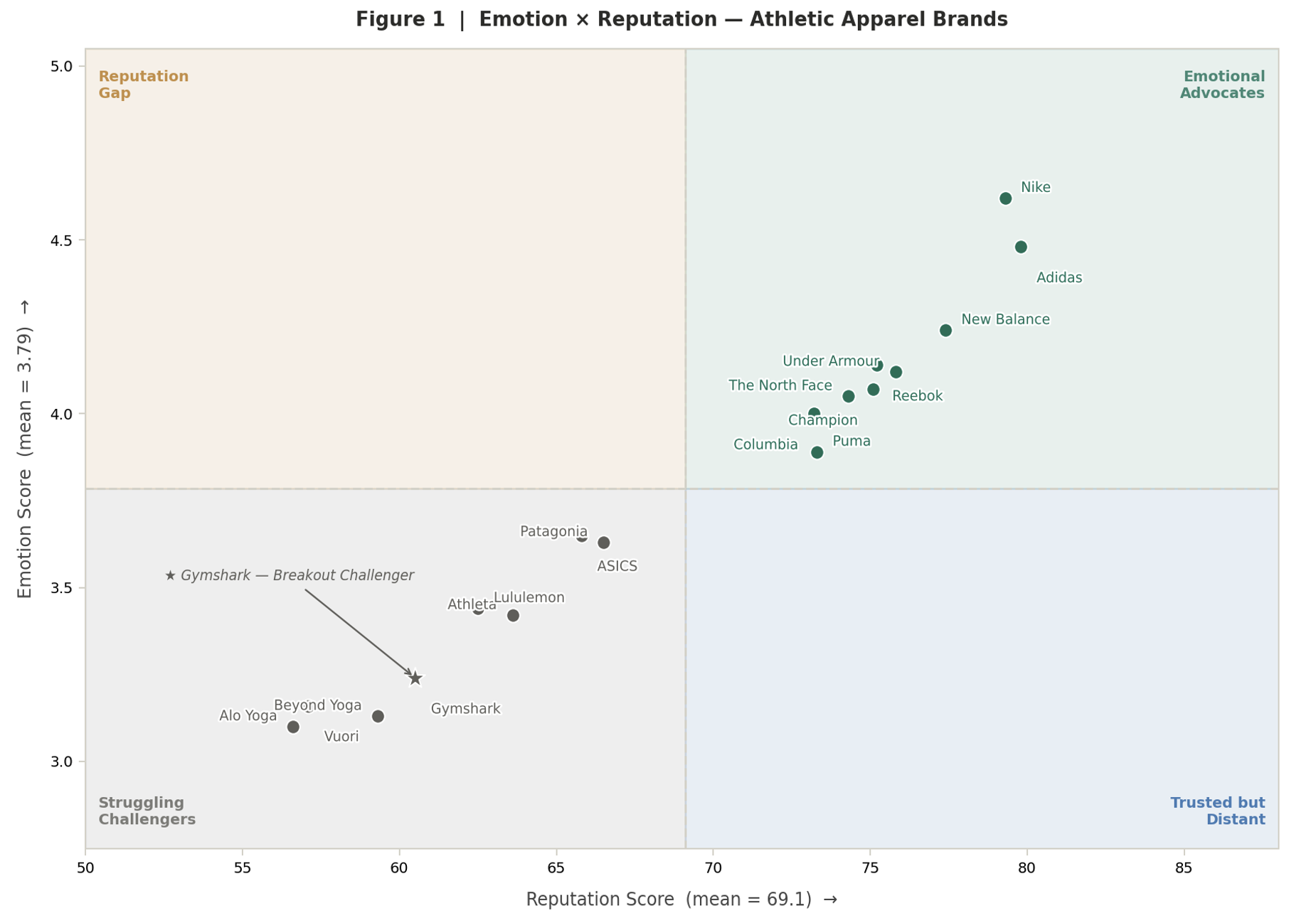
Figure 1 | Emotion x Reputation quadrant. Crosshairs at category means (Rep = 69.1; Emotion = 3.79). ★ denotes breakout challenger.
The Emotional Advocates tier is led by Nike (rep 79.3, emotion 4.62) and Adidas (79.8, 4.48), the two brands that dominate both the mental market share tables and the emotional closeness measure. Nike's 22% Mental Market Share and 10.3-CEP network give it a compounding structural advantage: consumers encounter it across more purchase occasions than any competitor, reinforcing emotional familiarity. Adidas holds a comparable reputation with a slightly narrower occasion footprint, driven by its strong position on versatility and style. New Balance (77.4, 4.24) has built genuine emotional depth with Gen X and Boomers, where its reputation scores climb above 80, anchored by its everyday comfort association..
Further back in the Emotional Advocates zone, Under Armour (75.8, 4.12), Reebok (75.2, 4.14), The North Face (74.3, 4.05), and Columbia (73.2, 4.00) all clear both means. Their margins are narrower, and their generational profile is uneven in ways Figure 1 does not show. Under Armour's SE average among Gen Z (38.3%) trails Nike by 21 points in that cohort. Younger consumers know the brand and use it; they have not made it part of their identity. Reebok carries strong heritage recognition among older cohorts, scoring above the rep mean with Boomers at 79.1%, but shows weaker emotional engagement with Gen Z. Maintaining Emotional Advocate status requires active generational investment, and for several of these brands, that investment is overdue.
The Trusted but Distant tier — Puma (73.3, 3.89), Patagonia (66.5, 3.63), and ASICS (65.8, 3.65) — all hold functional credibility while sitting below the emotion mean. Patagonia's position here is the most instructive. Its reputation score is suppressed by unfamiliarity rather than by hostility: nearly 29% of respondents answered "don't know / no opinion" on favorability, and 31.9% on value. Among those who hold an opinion, trust scores 69.9%, and community impact net is +31.5%. Decades of purpose-led positioning, from the "Don't Buy This Jacket" campaign to its 2022 ownership restructuring in favor of environmental causes, have built a reputation that simply has not reached a broad audience. The Comms mandate here is scale without dilution.
Patagonia is a conviction purchase for those who know it, and an invisible one for those who don't.
The Struggling Challengers cluster sits below both means and includes the category's most culturally visible brands, as well as its smallest players. Lululemon (62.5, 3.44) is the most strategically significant case. It has strong cultural recognition, associated with fashion and style at 14.6% and youth culture at 10.8%, yet its emotion score sits in the bottom half of the field. The explanation lies in unfavorable data: 10.7% of adults hold a very unfavorable impression of the brand, climbing to 18.7% among Gen Z. Its pricing and exclusivity create active reputation friction with the generation it aspires to own. Ongoing greenwashing litigation over its "Be Planet" claims adds a values-consistency layer to that friction that pricing alone cannot explain. Alo Yoga (56.6, 3.10), meanwhile, carries its own web research shadow: litigation alleging undisclosed paid influencer promotions sits directly athwart a brand identity built on an authentic wellness community.
The feeling layer adds texture
Figure 2 maps Feeling against Emotion and reveals a category where consumer sentiment runs cold rather than hot. No brand sits in the Emotionally Charged Critics zone. The risk is not backlash; it is indifference. A large cluster of brands has settled into a state of loose familiarity with consumers, and in a category where 62.6% already cite price as their primary frustration, that looseness is a thin defense against competitive displacement.
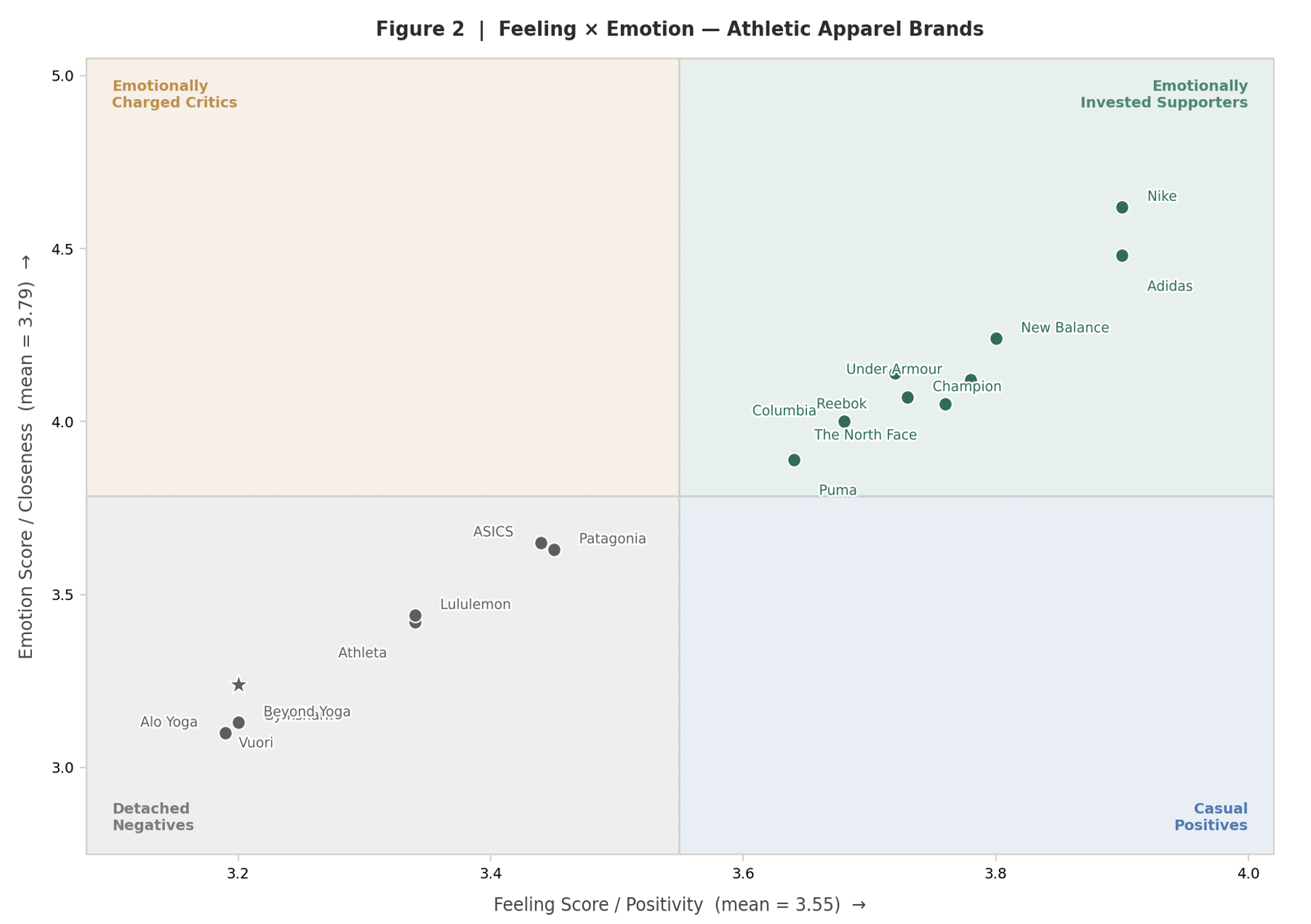
For the Casual Positives, Puma and ASICS in particular, the Comms mandate is occasion specificity: warmth without a clear reason to choose is not a purchase driver. Puma needs an owned occasion; ASICS needs a reason to be considered beyond its core running audience. For the Detached Negatives cluster, covering the premium challengers, the mandate is more fundamental. Gymshark, Vuori, Alo Yoga, and Lululemon all need to move consumers from passive awareness to active identification. Content that builds community, consistently demonstrates values, and connects the product to real-life occasions is the path. For Alo Yoga, the urgency is compounded by litigation alleging undisclosed paid influencer promotions: a brand whose equity rests on an authentic wellness community cannot afford a credibility gap between the life it portrays and the practices behind it.
Gymshark's window
Gymshark is the most strategically interesting brand in the study and the least reputationally prepared for what it has already built. It leads the gym/training CEP at 36%, ahead of Under Armour at 35%, with 13% brand awareness against Nike's 83%. Its MMS among 18-34-year-olds is 2.5%, more than double its national figure of 1.2%. By Category Advantage metrics, it is outperforming its size in the exact category that is growing fastest among Gen Z and younger Millennials.
Its reputation scores tell a different story. With a reputation index of 60.5 and an emotion score of 3.24, both below category means, Gymshark has built occasion ownership without earning brand permission. The SE radar in Figure 3 highlights the gap in specific terms: across all four self-expansion dimensions, Gymshark trails the legacy brands by 13 to 30 percentage points. Only 23.1% of consumers say they feel proud wearing the brand. These numbers reflect a brand that has not yet converted category presence into identity.
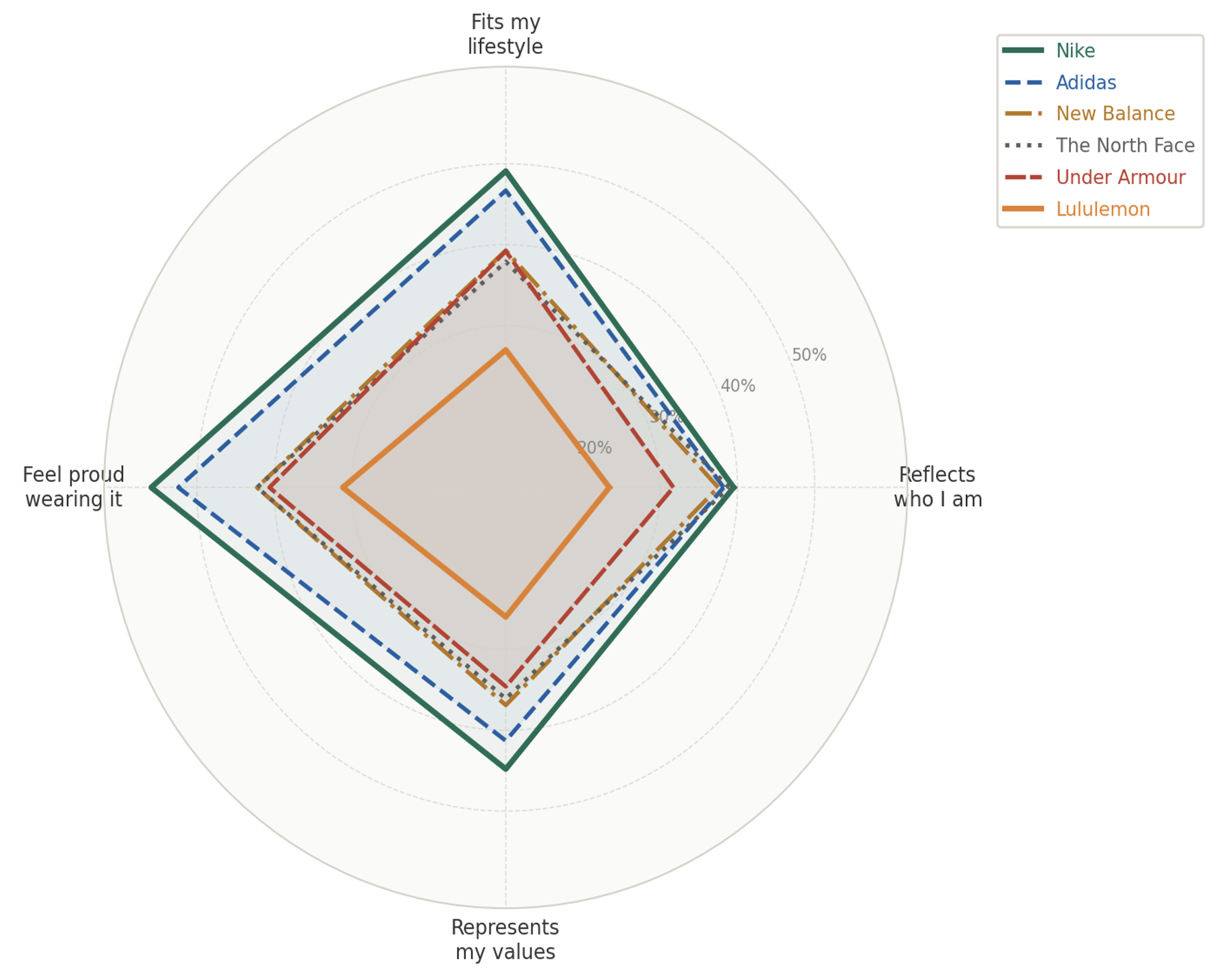
Figure 3 | Self-Expansion scores (Top-2-Box %). Champion excluded for analytical focus.
The generational profile sharpens the urgency. Gymshark's SE average among Millennials (34.0%) is substantially higher than its adults score (23.2%), but its Boomer SE floor sits at 7.2%, the lowest of any brand in the study. Its equity is concentrated in a single cohort window. The fitness influencer ecosystem that built its awareness, relevant to 19% of Gen Z versus 7.6% of all adults, is a competitive advantage only as long as no better-resourced brand decides to own the same channel more credibly. Nike already leads on both youth culture association (39%) and authenticity (44%). The window for Gymshark to build a reputation foundation that outlasts its influencer advantage is open now, and it will not remain so indefinitely.
Where brands win and where they are exposed: a generational view
The table below uses the Self-Expansion average as the primary measure of earned meaning per generation: reading across any row reveals whether a brand's earned meaning is consistent across generations or concentrated in a single cohort window.
|
BRAND |
Adults |
Gen Z |
Millennials |
Gen X |
Boomers |
SIGNAL |
|
Nike |
47.3% (EA) |
47.3% (EA) |
59.3% (EA) |
49.9% (EA) |
29.9% (EA) |
↑ strong across all gens |
|
Adidas |
44.6% (EA) |
47.9% (EA) |
53% (EA) |
48% (EA) |
29.4% (EA) |
↑ Millennials peak |
|
Under Armour |
36.5% (EA) |
38.3% (EA) |
41.9% (EA) |
39.5% (EA) |
25.9% (EA) |
⚠ Gen Z meaning gap |
|
New Balance |
39% (EA) |
44.4% (EA) |
41.5% (EA) |
43% (EA) |
29.2% (EA) |
↑ Gen X & Boomer strength |
|
Lululemon |
26.9% (SC) |
32.9% (SC) |
36.1% (SC) |
26.6% (SC) |
12.7% (SC) |
⚠ weak all gens; Boomer lowest |
|
Gymshark |
23.2% (SC) |
29.8% (SC) |
34% (SC) |
22.2% (SC) |
7.2% (SC) |
⚠ Boomer floor (7.2%) |
|
Patagonia |
31.1% (SC) |
30.9% (SC) |
38.5% (SC) |
31.2% (SC) |
22% (TD) |
◑ strongest with Boomers |
|
The North Face |
38.8% (EA) |
39.8% (EA) |
44.6% (EA) |
42.3% (EA) |
28% (EA) |
↑ consistent; Mlnls peak |
|
Reebok |
36.7% (EA) |
38.8% (TD) |
38.8% (EA) |
43.7% (EA) |
26.6% (EA) |
◑ Gen X & Boomer strength |
|
Alo Yoga |
23.2% (SC) |
28.1% (SC) |
33.5% (SC) |
22.8% (SC) |
8.4% (SC) |
⚠ Gen X & Boomer very low |
EA = Emotional Advocate | TD = Trusted but Distant | SC = Struggling Challenger | SE = Self-Expansion average (Top-2-Box %, four identity dimensions) | Quadrant calculated against generation-specific means.
Two findings from this table carry specific Comms weight. Under Armour holds Emotional Advocate status across all five segments, including Gen Z, where its emotion score (4.46) exceeds the Gen Z mean. Yet its Gen Z SE average (38.3%) trails its Millennial score (41.9%) and falls 21 points behind Nike in that cohort. Under Armour has reach with young consumers but has not converted that reach into the identity-level meaning that drives long-term equity. Its comms challenge is focused: the performance heritage story that works with Gen X and Millennials needs a comfort-and-versatility translation to land with a generation for whom athletic apparel is a lifestyle signal as much as a functional purchase. Patagonia moves in the opposite direction, improving its reputation tier with Boomers, where its purpose-led history translates into genuine conviction. The task there is to scale that credibility to younger audiences who expect supply-chain evidence, not brand statements.
What the permission gap costs and how to close it
For the Emotional Advocates tier, the primary risk is generational erosion: strong aggregate scores masking a decline in emotional ground among younger cohorts. Nike and Adidas face this least acutely. Under Armour faces it most directly. Its reputation floor is solid, but the identity-level connection that would make it the default choice for a Gen Z consumer remains to be claimed. Its association with everyday comfort sits at 11.3%, lower than its market position warrants. The specific action is to shift communication toward the comfort-and-versatility occasion, which is growing fastest among 18-34-year-olds, with a defined and reachable audience.
For the Trusted but Distant brands, the prescriptions diverge. Puma needs an owned occasion in the gym-to-street versatility space, currently unclaimed by any heritage brand, to anchor its reputation. Patagonia does not need to redefine itself; it needs to scale its known values to audiences that have not yet encountered them, with evidence that meets Gen Z's supply-chain standard rather than brand-level statements.
For Gymshark and the premium challenger cluster, the shared mandate is to build reputation while the Category Advantage window stays open. For Gymshark: community impact storytelling, transparent values content, and a clear answer to what the brand stands for beyond performance aesthetics. The influencer model drives awareness; SE data confirms it has not been sufficient for meaning. For Lululemon, the 18.7% very unfavorable rate among Gen Z is the priority signal. Connecting value to durability and performance substance is the credibility bridge the data says is currently missing.
The category's defining communications challenge
Athletic apparel is the first major lifestyle category to face simultaneous disruption at the occasion layer and entrenchment at the reputation layer. Legacy brands hold trust but are not converting it into emotional closeness with younger cohorts. Challengers have built occasion ownership without establishing the permission foundation that makes it durable. That combination is unusual and creates a specific kind of instability: the brands with the strongest reputations are not always the ones gaining ground on the occasions that matter most, and the brands gaining ground on those occasions are the least prepared to defend what they have built.
The category's central tension, consumers redefining athletic apparel as lifestyle apparel while many brands still sell sportswear, runs through every layer of this data. The comfort-first futures signal, the price-justification frustration, the athleisure occasion growth, and the generational divergence over what performance means. Brands that resolve that tension in their communications by earning the right to own both the comfort and performance stories will hold positions that are structurally difficult to contest. Those that remain anchored to a sport-first identity in a comfort-first market will find their Category Advantage quietly narrowing in the cohorts where the next decade of spending is being formed.
The permission gap in athletic apparel is closing, signaled by durability narratives for premium challengers, authenticity investments for legacy brands losing younger cohorts, and a category-wide recognition that the most important reputation question has shifted. It is no longer "Does this brand perform?" It is "Does this brand belong in my life?" What we are seeing is that brands grow by increasing the number of consumers who feel emotionally connected to them, and emotional connection is built through consistent, relevant communication across the occasions that matter to each cohort. For every brand watching its generational numbers, that is the strategic brief. The brands that answer it first will own territory that no amount of spending can buy back later.
Methodology
Morning Consult online survey of 1,003 U.S. adults aged 18+, fielded May 23–24, 2026 (Poll ID: 2605180). Sample weighted to match U.S. Census targets for age, gender, race/ethnicity, education, and geography. Unweighted margin of error ±3.1 percentage points at the 95% confidence level. Reputation Score is the average of five components: favorability, trust to do what is right, good value, positive community impact, and employer admiration (each calculated as top-box percentage of valid, non-DK responses). Emotion Score is a weighted mean on a 1–7 closeness scale (higher = more connected). Feeling Score is a weighted mean on a 1–5 positivity scale (higher = more positive). Self-Expansion Average is the mean top-2-box percentage across four identity statements. Quadrant breaks use category means, not range midpoints. Mental Market Share, Network Size, and Category Entry Point data from Morning Consult Category Advantage, Athletic Apparel, May 18, 2026.

Why Consumer AI’s Adoption Story Has Outrun Its Reputation
.png)
Reputation Activation: Why Modern Communications Needs a New Kind of Intelligence